07 October 2026
FROM BLACKOUT TO RESTORATION: INTERNSHIP ASSESSES THE BLACK-START CAPABILITY OF THE VALVERDE PILOT MICROGRID
Pedro Martins has completed his KTH Royal Institute of Technology master’s thesis at R&D Nester, addressing an increasingly relevant question: can a community equipped with solar panels and batteries bring itself back online, without waiting for the main grid?

The internship took place within the U2Demo project, at the Portuguese pilot site in Valverde, Évora, and focused on black-start: the ability of a microgrid to re-energise autonomously after a complete blackout.
In a traditional grid this is led by large synchronous generators; in a microgrid made up only of photovoltaic generation and batteries, no rotating machine is available to do so, and the voltage and frequency reference must be created by inverter control.

THE WORK DEVELOPED
Pedro modelled the microgrid in MATLAB/Simulink with Simscape Electrical, a neighbourhood of 14 households, each with 1.5 kWp of photovoltaic generation, plus an aggregated battery energy storage system (BESS).
The BESS provided the reference in grid-forming mode (virtual synchronous generator, VSG), while the PV injected power in grid-following mode (PQ control).
Four case studies were simulated, combining winter conditions (peak load, no solar generation) and summer conditions (peak generation, reduced load) with simultaneous or staged load pickup, assessed through voltage, frequency and harmonic distortion against EN 50160 and IEEE 519-2022.
TOOLS AND DELIVERABLES
• A Simscape model of the pilot microgrid, calibrated with real site data and validated by R&D Nester;
• A black-start simulation framework: scenario definition, integration of load and generation profiles, and the scripts for the four case studies;
• Processing of a full year of real measurements (June 2025 to June 2026, at 15-minute intervals) from three reference households, converted into RL impedances and irradiance values;
• The master’s thesis, defended at KTH.
RESULTS AND CONTRIBUTION TO R&D NESTER
There is a minimum BESS power rating below which black-start simply does not happen: under the most demanding winter conditions, the 30 kW and 40 kW configurations failed to recover nominal values, whereas from 50 kW upwards the system recovered almost completely. The behaviour is not gradual, it either fails or succeeds, with very little middle ground. Staged load pickup further reduces the severity of voltage and frequency transients, without changing the final operating point.
For R&D Nester, the work leaves quantitative guidance on storage sizing for Valverde and a reusable model for the next phase, already identified: resynchronisation and grid-connected operation.

KNOW-HOW AND POINTS OF INTEREST
The internship consolidated skills in modelling power electronic converters in Simscape Electrical, in grid-forming and grid-following control strategies, and in turning real pilot data into simulation parameters.
One finding worth highlighting is how the direction of the disturbance reverses between seasons: in winter the microgrid must compensate for a power deficit and voltage drops below nominal; in summer, with surplus PV generation, the opposite happens: voltage rises and the BESS switches to absorbing energy.
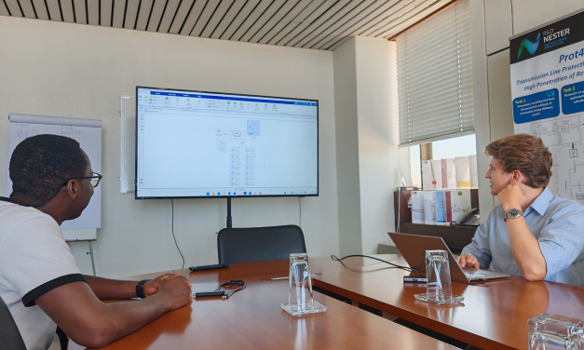
R&D Nester thanks Pedro Martins for his work and wishes him every success in his professional career.
Internship carried out at R&D Nester, within the U2Demo project, supervised by Gonçalo Gloria and Inoussa Laouali with academic supervision from Daniel Månsson (KTH). Examiner: Lars Nordström (KTH).